Orange Glazed Scottish Shortbread

Here is my popular Scottish shortbread recipe, this time with an orange flavoured icing/glaze. A super simple method of decorating & customizing for any season, this is still based on a truly traditional & Scottish shortbread recipe.
Equipment
- Scales or measuring cups
- Large spoon
- Stand or Hand Mixer, (or Medium-Large Mixing bowl & spoon)
- Pastry Cutter/pastry blender (optional)
- Baking/parchment paper
- Baking Sheet/Tray x 2
- Cookie Cutters (Various shapes & sizes, see notes*)
- Palette knife or sharp kitchen spatula
- Cooling rack
- Fruit zester
- Small Bowl (for making glaze & dipping)
- * See Notes after Recipe Card
Ingredients
Basic Shortbread Dough
- 225 grams Butter, unsalted, cubed & softened (1 cup/2 sticks or 8 oz)
- 110 grams Caster Sugar (3¾ oz), ½ cup Extra/super fine sugar)*
- 225 grams Plain Flour (1 ¾ cups All Purpose or 8 oz)
- 110 grams Corn Flour (3¾ oz, 1 cup less 1 tbsp Corn Starch)
- Pinch of Salt
Orange Cranberry Nut Version
- 2 tsp Orange Extract (Or zest of 1 orange)
- 73 grams Dried Sweetened Cranberries (1¼ cup, 2½ oz)
- 52 grams Pecans, roughly chopped (¾ cup, 1¾ oz - Optional - hazelnuts, walnuts & even mixtures work well)
For The Glaze
- 250 grams Icing Sugar (8¾ oz, 2 cups, Powdered Sugar)
- 2 tsp Orange Extract (optional)
- 1 Orange (juice & zest)
* Denotes, see notes

Instructions
Prepare The Biscuit Dough
- Cube the butter to small pieces about 1cm (⅓”) size since smaller surface area will soften faster. In a hurry? Try this video hack for softening in about 12 minutes.
- Mix the softened butter & sugar briefly by hand, before using a hand-mixer or stand-mixer to 'Cream' the butter & sugar.
- Prepare 2 or 3 baking/cookie sheets/trays with baking/parchment paper & grease in place if they don't have any lip.
- Sieve the flour, cornflour (corn starch) & salt over the butter/sugar mixture & start to mix by hand. Use a pastry cutter (pastry blender), 2 butter knives, or your fingertips to work the flour into the butter. *(For more details see the step-by-step instructions before this Recipe Card.) **Please note the mixture will be crumbly & not coming together into a ball shape yet.
- In the mixing bowl or on floured paper, gently squeeze the dough with your hands till it comes together. Form into a rough rectangular or square shape about 4"/10cm wide.
Flavouring The Shortbread
- If you want to flavour and add nuts & cranberries, do so now, by adding in 3 increments and folding the dough over itself to work in the extra ingredients. (see my Cranberry Orange Pecan Scottish Shortbread video for the process.) Now form into a rectangular/square shape again & chill for 10 minutes to relax the dough. *Tip – chill the shortbread dough, wrapped well in cling film/plastic wrap, in the fridge overnight if needed.
Cutting Out The Shortbread
- Flour baking/parchment paper or a counter/worktop & roll out the shortbread dough to a thickness of about 1-1½ cm ( ⅓– ⅔“). *Tip - use 2 sheets of paper to keep the rolling pin clean. Cut out the shortbread shapes using a cookie cutter dipped in flour first. Use different sizes of the same shape cutter (such as hearts or stars), and cut out the centre. (See step-by-step photos for more details). Carefully transfer the shortbread shapes to the paper-lined baking trays/baking sheets (no need for gaps in-between just yet). Form the excess dough into a ball & roll out to make more shortbread shapes.
Chill The Shortbread Dough
- Chilling of the shortbread should not be omitted. For perfect shaping, first place the shortbread shapes in the fridge for 30 minutes. Then very gently remove from the fridge and use a wooden cocktail stick to 'Dock' the shortbread pieces. (Make plenty of holes being careful not to break the dough). Next place the shortbread shapes in the freezer for 30 minutes. **Tip - if short on space, stack the cold shortbread on top of each other, on a smaller tray or plate, just make sure it is flat & paper lined & able to fit in your freezer.
- Alternatively, cover the shortbread with cling film/plastic wrap and leave in the fridge overnight or for up to 2 days maximum, and bake directly from the fridge. Before the time is up, set your oven to heat to 180°c/160°c Fan/350°f/Gas Mark 4.
Bake The Shortbread
- Bake 2 baking trays/baking sheets of the shortbread, in the centre of the oven for 14-18 minutes. Timing will vary depending on size and if your shortbread has cut-out centres, but make sure the edges are only just starting to turn a very pale golden colour (similar to sugar cookies). Rotate & turn the trays/sheets if needed, but after 8 minutes. Test by gently pushing the biscuit, which should move but still be soft.
- Leave the baking tray/sheet to cool on a cooling rack for 10 minutes, before transferring to the cooling rack using the paper (be very careful not to break the shortbread. Easiest way is to pull one end of the paper and slide the shortbread (and paper), onto the cooling rack ). Meanwhile bake the rest of the shortbread. Leave to cool down completely before decorating. **You can place in a tin once cool and decorate the next day.
Glazing The Shortbread
- Sieve the icing/powdered sugar into a bowl and very very gradually add in 2 tsp orange extract. The mixture will change from powder into a thick paste. Now gradually, add enough orange juice until you have a thick but pourable glaze. Test by lifting with a small spoon and watching how it falls off the spoon. If it leaves a trail on the surface of the glaze, it is thick enough.
- **You can add a little of the orange zest to the glaze to help colour it a pale orange colour, or only add the zest as a final touch.
- Carefully dip the top of one of the cooled shortbread biscuits in the bowl of orange glaze. Lift and let some of the glaze drip back into the bowl, before swiftly turning the right way up, at the same time as using a small spoon to scrape off the excess glaze from the edge of the biscuit. If dipping shortbread with a cut-out centre, use the spoon to guide the glaze down the centre edges.
- Place on the cooling rack, placed on top of some baking/parchment paper to catch any drips. Sprinkle on some orange zest and leave for the glaze to set.


Serving & Storing
- Enjoy the glazed Scottish shortbread with tea or coffee or add to a gift basket for a beautiful & thoughtful food hamper.
- Store cooled Scottish shortbread in an airtight tin or container for at least 7 days. Metal cake or cookie tins are highly recommended. I have had Scottish shortbread still taste great after 14 days.


Video
Notes
Cookie Cutter - for these photos I used a combination of sizes and shapes, as well as cut-outs. The smallest was the tiny hearts at about 4cm (1¾"), with bigger heart cutters ranging up to 6.25cm (2.5″). The longest were the carrot/bunny ones at about 7.5cm (3″).
Caster Sugar - US equivalent Extra/Super Fine Sugar. Process your own from Granulated sugar - see my sugar comparison photos before this Recipe Card. Alternative Ingredients - hazelnuts and walnuts work well, as do chocolate chips.
Recipe Yield/Servings - quantity made will vary according to the size & shape of your cutters, as well as if you make centre cut-outs. Provided your cutters are not extra large, it will make a minimum 24 biscuits or as many as 41 if using the smallest heart cookie cutter.
Alternative Ingredients - hazelnuts and walnuts work well, as do chocolate chips.
Recipe Yield/Servings - quantity made will vary according to the size & shape of your cutters, as well as if you make centre cut-outs. Provided your cutters are not extra large, it will make a minimum 24 biscuits or as many as 41 if using the smallest heart cookie cutter.
 Scottish Shortbread Tips
*Don't omit the Cornflour (Corn Starch), as it gives the melt-in-the-mouth texture. As well as proper butter, this makes a traditional Scottish recipe we are used to here in Scotland.
*Only very light, minimal kneading to bring dough & inclusions together.
*Do not skip the chilling stage - very important for most biscuit/cookies.
*Don't over-bake - should be pale like sugar cookies, firm up on cooling & be a very soft delicate texture.
Scottish Shortbread Tips
*Don't omit the Cornflour (Corn Starch), as it gives the melt-in-the-mouth texture. As well as proper butter, this makes a traditional Scottish recipe we are used to here in Scotland.
*Only very light, minimal kneading to bring dough & inclusions together.
*Do not skip the chilling stage - very important for most biscuit/cookies.
*Don't over-bake - should be pale like sugar cookies, firm up on cooling & be a very soft delicate texture.
 Please see the detailed recipe process photos & further information, before this Recipe Card. Where readers' pics and feedback page can also be found.
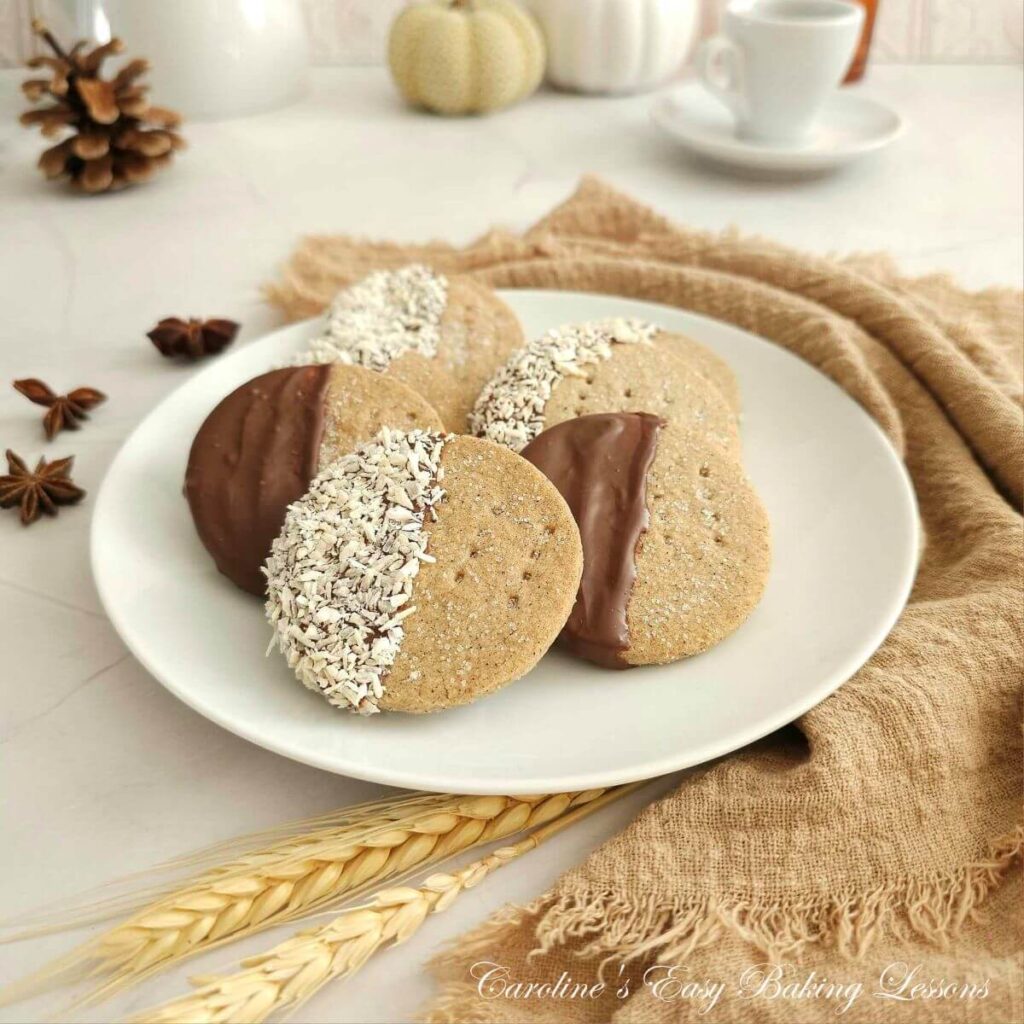
See my original Scottish Shortbread recipe, or Chocolate & Coconut Scottish Shortbread (shown above).
Please see the detailed recipe process photos & further information, before this Recipe Card. Where readers' pics and feedback page can also be found.
See my original Scottish Shortbread recipe, or Chocolate & Coconut Scottish Shortbread (shown above).
 Please take a few seconds to rate this post & recipe - thanks, Caro xx
Or jump to the Christmas recipes page.
Please take a few seconds to rate this post & recipe - thanks, Caro xx
Or jump to the Christmas recipes page.
NUTRITIONAL VALUES – I am not a qualified nutritionist, and all nutritional values approximate & based on a serving of 1 rectangular/finger biscuit (similar in size to the bunny/carrot cookie cutter), with the added cranberries & nuts & where recipe yield is about 32 rectangular biscuits/cookies. Make more or less cookies & the nutritional values will change. Values calculated from website My Fitness Pal.com.
Caster Sugar - US equivalent Extra/Super Fine Sugar. Process your own from Granulated sugar - see my sugar comparison photos before this Recipe Card.
Alternative Ingredients - hazelnuts and walnuts work well, as do chocolate chips.
Recipe Yield/Servings - quantity made will vary according to the size & shape of your cutters, as well as if you make centre cut-outs. Provided your cutters are not extra large, it will make a minimum 24 biscuits or as many as 41 if using the smallest heart cookie cutter.
Scottish Shortbread Tips
*Don't omit the Cornflour (Corn Starch), as it gives the melt-in-the-mouth texture. As well as proper butter, this makes a traditional Scottish recipe we are used to here in Scotland.
*Only very light, minimal kneading to bring dough & inclusions together.
*Do not skip the chilling stage - very important for most biscuit/cookies.
*Don't over-bake - should be pale like sugar cookies, firm up on cooling & be a very soft delicate texture.
Please see the detailed recipe process photos & further information, before this Recipe Card. Where readers' pics and feedback page can also be found.
See my original Scottish Shortbread recipe, or Chocolate & Coconut Scottish Shortbread (shown above).
Please take a few seconds to rate this post & recipe - thanks, Caro xx
Or jump to the Christmas recipes page.
NUTRITIONAL VALUES – I am not a qualified nutritionist, and all nutritional values approximate & based on a serving of 1 rectangular/finger biscuit (similar in size to the bunny/carrot cookie cutter), with the added cranberries & nuts & where recipe yield is about 32 rectangular biscuits/cookies. Make more or less cookies & the nutritional values will change. Values calculated from website My Fitness Pal.com.
Nutrition Facts
Orange Glazed Scottish Shortbread
Amount per Serving
Calories
112
% Daily Value*
Fat
7.12
g
11
%
Saturated Fat
4
g
25
%
Polyunsaturated Fat
1
g
Monounsaturated Fat
2
g
Cholesterol
15
mg
5
%
Sodium
50
mg
2
%
Potassium
10
mg
0
%
Carbohydrates
11.37
g
4
%
Sugar
5
g
6
%
Protein
1
g
2
%
* Percent Daily Values are based on a 2000 calorie diet.